Track Day Basics: What a First-Timer Needs to Know
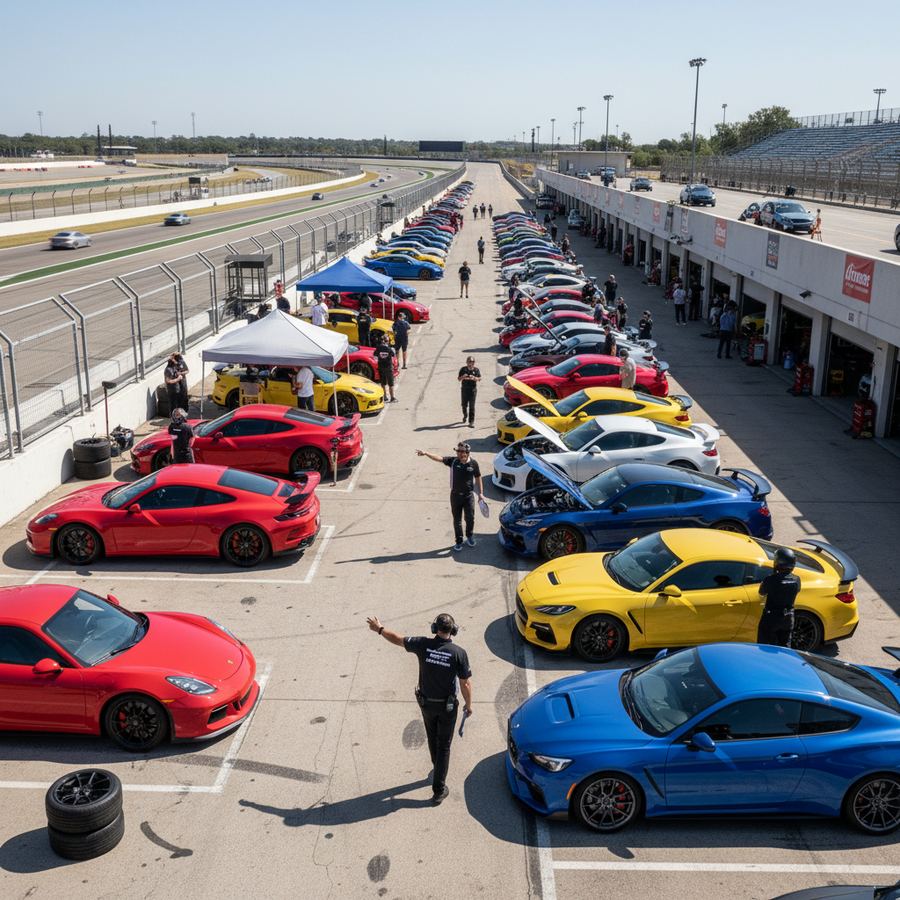
A track day puts you on an actual racetrack, with real turns, elevation changes, and long straights. But you are not racing. You are learning. The format is called HPDE (High Performance Driver Education), and it exists specifically for street-car drivers who want to learn vehicle dynamics at speed in a structured, safe environment.
This is not about going fast on day one. It is about learning how your car behaves when you ask more of it than the street ever allows.
What HPDE Actually Is
HPDE is an instructional program run on a closed racetrack. Organizations like NASA (National Auto Sport Association) and various regional clubs organize these events at tracks across the country. The format is consistent: classroom sessions in the morning, on-track driving sessions throughout the day, and an instructor assigned to you for guidance.
The emphasis is on learning, not lap times. Most HPDE organizations actually discourage timing yourself on your first few events because it shifts your focus away from technique and toward speed. Speed comes naturally once your technique improves. Chasing the clock before you have the skills is how people end up in gravel traps.
Run Groups
Drivers are split into run groups based on experience. The typical breakdown looks like this:
- Group 1 (Novice): First-timers and early-stage drivers. You will have an instructor in your passenger seat for every session. Passing is only allowed on straights, and only with a point-by from the car ahead.
- Group 2 (Intermediate): Drivers with several events under their belt. Instruction may be optional. Passing zones expand.
- Group 3 (Advanced): Experienced drivers with consistent car control. Open passing in most zones. No instructor required.
- Group 4 (Instructor/Expert): The fastest, most experienced drivers. Often includes the instructors themselves during their free sessions.
You will be in Group 1. That is exactly where you should be. The car-to-car spacing is wider, the speeds are lower, and you have a living, breathing coach sitting next to you telling you when to brake, where to look, and how to position the car. This is the best driver training available to civilians, and it costs less than one semester of a performance driving school.
Your Instructor
Your in-car instructor is a volunteer (usually) who has years of track experience and has been trained to teach from the passenger seat. They are not there to scare you or push you beyond your comfort level. Their job is to build your skills session by session.
In your first session, expect to drive at maybe 60-70% of what the car can do. Your instructor will point out reference points for braking, turn-in, and apex. They will correct your line, talk about vision (where your eyes should be), and help you understand weight transfer. By your third or fourth session of the day, you will be noticeably smoother and carrying more speed through corners without even trying to go faster.
Listen to your instructor. Ask questions between sessions. If something they said does not make sense, say so. Good instructors adjust their teaching to your learning style.
Corner Flags
The track is staffed with corner workers who communicate using flags. You must know these before you go on track:
- Green: Track is clear, full-speed driving.
- Yellow: Caution ahead. Slow down, no passing. Something happened in the next section of track.
- Red: Stop. Pull safely to the side of the track and stop. Do not drive to the pits. Stop where you are.
- Black (pointed at you): Report to the pits. You may have a mechanical issue, or the stewards need to talk to you. It is not necessarily punishment.
- Blue with orange stripe (Meatball): Mechanical issue on your car. Come into the pits.
- Checkered: Session is over. Complete your cool-down lap at reduced speed and return to the pits.
The morning classroom session will cover flags in detail. Pay attention to that part. Flags are the primary safety communication system on a racetrack, and ignoring one can get you permanently removed from an event.
Passing Rules
In the novice group, passing works on a point-by system. If a faster car catches you, they will follow you until you reach a designated passing zone (usually a straight). You check your mirror, confirm they are there, and point with your hand out the window toward the side you want them to pass on. They pass. Simple.
You are never required to go faster because someone is behind you. The point-by is your decision to give. If you are not comfortable, keep driving your line. The faster car can wait. Everyone understands. The only thing you should never do is brake-check or swerve unpredictably. Be predictable, use your mirrors, and give the point when you are ready.
What Your Car Needs
Track days have stricter tech requirements than autocross. Your car will need:
- Brake pads with adequate life remaining (this is a big one - track driving eats brake pads)
- Brake fluid that is not old and degraded (consider a flush with DOT4 before your first event)
- Tires with good tread and no damage
- A clean interior with all loose items removed
- A battery that is properly secured
- No fluid leaks of any kind
- A helmet rated Snell SA2015 or newer (M-rated helmets are accepted at some but not all events)
Your stock daily driver can absolutely do a track day. But brakes matter more here than anywhere else. If your brake pads are near the end of their life, replace them before the event. If your brake fluid has not been changed in two years, flush it. Overheated brakes that fade or fail are the most common mechanical problem at HPDE events, and it is entirely preventable.
The Day's Schedule
A typical HPDE day runs roughly like this:
- 7:00 AM: Gates open, registration, unload
- 8:00 AM: Mandatory drivers' meeting for all participants
- 8:30 AM: Novice classroom session (track map, flags, passing, car control basics)
- 9:00 AM: First run group goes on track
- 9:20-4:00 PM: Run groups rotate through 20-25 minute on-track sessions with breaks between
- 4:00 PM: Last session, pack up
You will get four to five on-track sessions over the course of the day, each about 20 minutes long. Between sessions, you cool down, check your car (tire pressures, fluid levels, brake feel), hydrate, and debrief with your instructor.
Cost
HPDE events typically run $150-350 per day depending on the track and organization. That is more than autocross but still accessible. Some organizations offer multi-day discounts. You will also spend money on gas (track driving uses a lot of fuel) and potentially on brake pads and fluid before or after the event.
Budget roughly $200-400 all-in for your first track day including entry, fuel, and any minor prep. If that is beyond your starting budget, autocross or rallycross can scratch the itch for less money while you save up for a track day.
The Single Biggest Misconception
People think track days are about going fast. They are not. Track days are about learning car control at a level that the street can never teach you. You will learn how weight transfers under braking, how tire grip works and where it runs out, how vision drives everything you do behind the wheel, and how much more capable your car is than you probably realized.
After a track day, you will drive better everywhere. On the highway, in parking lots, in the rain. The skills transfer completely. That is the real reason to do this.
Find your nearest track event through our event-finding guide, register, check your brakes, and go learn something about your car that the owner's manual never covered.