How Clubs Run Local Events
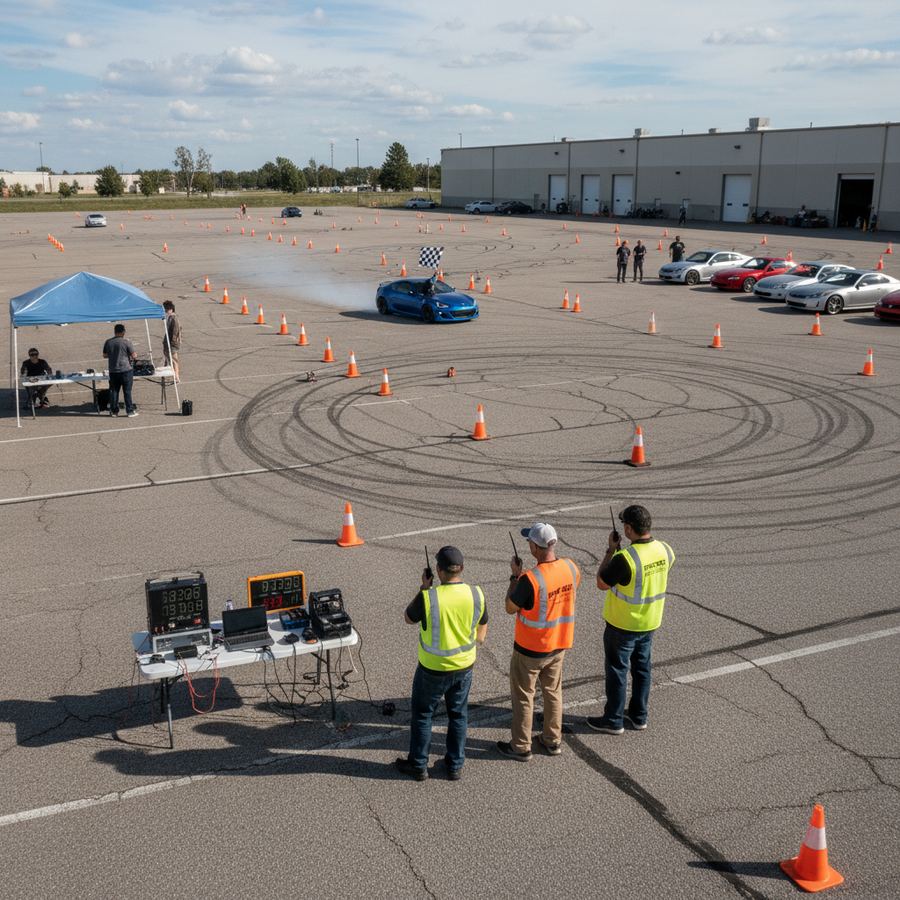
Every local motorsport event you attend exists because a group of volunteers decided to make it happen. There is no professional event staff at a Saturday autocross. There is no permanent infrastructure at most track days run by car clubs. The entire operation runs on people who care enough to show up early, stay late, and handle dozens of logistics problems so that everyone else can have fun driving. Understanding how this works makes you a better participant and a more valuable member of the community.
Who Runs These Events
The three most common organizers for grassroots motorsport events in North America are SCCA regions, NASA chapters, and independent car clubs.
SCCA (Sports Car Club of America) is the largest amateur motorsport organization in the country. It is divided into regions, and each region operates semi-independently. Your local SCCA region handles its own autocross schedule, track day programs, and regional racing series. The national organization provides the rulebook, insurance framework, and sanctioning, but the actual events are organized and run by regional volunteers. Most SCCA autocross programs run monthly from spring through fall.
NASA (National Auto Sport Association) focuses more on track events, including high-performance driving education (HPDE), time trials, and wheel-to-wheel racing. NASA chapters operate at specific tracks and run multi-day weekend events. The structure is more formalized than a typical club autocross, with dedicated instructors, run groups separated by experience level, and stricter car preparation requirements.
Independent clubs fill the gaps. BMW CCA, PCA (Porsche Club of America), Miata clubs, Corvette clubs, and dozens of other marque-specific and general enthusiast groups run their own events. Some of these are huge organizations with professional-grade operations. Others are ten friends who rented a parking lot. Both are valid and both produce great events.
Securing a Venue
The hardest part of running a local event is finding somewhere to do it. Autocross needs a large, flat, paved area with no light poles, curbs, or obstacles. Airport lots, stadium parking lots, business parks on weekends, and fairground lots are the usual options. The club negotiates a rental agreement with the property owner, which includes insurance coverage and liability terms.
These relationships are fragile. One complaint from a neighbor, one piece of trash left behind, one driver doing something stupid on public roads near the venue, and the club loses access. This is why event organizers are strict about noise, speed in the paddock, and cleanup. They are protecting a relationship that took years to build.
Track events are simpler in one sense because the venue is purpose-built, but track rental fees are significant. A club might pay $5,000-$15,000 to rent a track for a day, depending on the facility. This is why track day entry fees are higher than autocross fees. The math has to work or the club loses money.
Course Design
At an autocross, the course is built fresh for every event. A course designer (usually an experienced competitor who volunteers for the role) creates a layout that fits the available space, provides an interesting driving challenge, and is safe. They balance tight technical sections with faster sweeping sections, design the course to keep speeds manageable, and make sure there is adequate runoff in case someone misses a turn.
Course design happens the morning of the event. The designer arrives early and a volunteer crew helps place hundreds of cones according to the plan. Each cone position is marked with chalk so displaced cones can be reset quickly during competition. The best courses are intuitive enough that a first-timer can follow the layout after a course walk, but challenging enough that experienced drivers are still searching for time on their last run.
Tech Inspection
Before anyone drives, every car goes through tech inspection. Tech inspectors are volunteers, usually experienced drivers who know what to look for. They check for safety items: battery secured, lug nuts tight, brake lights working, no fluid leaks, nothing loose in the interior, helmet meets the required Snell rating.
Tech is not a full mechanical inspection. They are catching obvious hazards: a car leaking oil onto the course, a loose battery that is a fire risk, floor mats that could slide under the brake pedal. Some organizations use self-tech with a checklist. Others require a volunteer to physically check each item. Either way, doing your own thorough inspection at home before the event is always a good idea.
Timing and Scoring
Autocross timing is handled electronically. The standard setup uses a pair of infrared timing lights at the start and finish, connected to a computer running timing software. When your car breaks the beam at the start, the clock starts. When you cross the finish beam, the clock stops. Cone penalties (typically two seconds per cone hit) and off-course penalties (a DNF or a large time penalty) are added to your raw time.
The timing crew records penalties called in by radio from corner workers and posts results in near-real-time. Track day timing varies. Some events are untimed, focused on seat time and instruction. Others use transponder-based systems for automatic lap timing and official scoring.
Work Assignments
This is the part that surprises most first-timers. At an autocross, you do not just show up, drive, and leave. Drivers are divided into run groups, and when your group is not driving, you are working the course. This means standing at a corner station, watching for displaced cones, and resetting them after each car passes.
Work assignments are not optional. Without corner workers, there is no one to reset cones, flag safety issues, or communicate with timing. A typical autocross splits drivers into two or three groups that alternate between driving and working. You might drive in the morning and work in the afternoon, or alternate every few runs.
At track days, the structure is different but the volunteer ethic is the same. NASA and SCCA track events need corner workers, grid workers, pit lane marshals, and people to staff registration. Many track day organizations give discounted or free entry to drivers who volunteer for extra duties.
The People Who Make It Happen
Behind every event is a core group of volunteers who handle the things most participants never think about. Someone negotiated the venue contract. Someone maintains the timing equipment. Someone manages the registration system and handles refunds when it rains. Someone brings the cones, the fire extinguishers, the radios, and the first aid kit. Someone designed the course, someone set it up at 6:30 AM, and someone will pick up every single cone after the last car finishes.
These are not paid positions. The event chair, the registrar, the chief of timing, the course designer, the safety steward. Every one of them has a day job and spends their free time making events happen because they love the sport.
When you understand this, the expected etiquette at events makes complete sense. Helping pick up cones at the end of the day is not a suggestion. Showing up to your work assignment on time is not optional. These are the minimum contributions to a system that gives you affordable access to grassroots motorsport. If you attend regularly and enjoy it, consider volunteering for a board position. The clubs always need help.